
On Style
Style is ethics, aesthetics, poetics – not fashion, not at any age. Even if we wear purple - or just a tasteful shade of grey.

Style is the answer to everything
A fresh way to approach a
Dull or dangerous thing
— Charles Bukowski
Erica sends ‘Style is the answer’1, a techno mix, a take on Bukowski’s Style2.
I look up a reading of it by its author - his live readings legendary, ‘a drunk raucous crowd fighting with the drunk angry poet’3. I read a collection of his poems over Christmas – an uncomfortable reading as words as bright as day leap out amongst violence, vulgarity, misogyny.
‘Style’ haunts me – it is a beautiful poem, witty and rich. There’s more to style than I thought.
In western everyday discourse, style is often simply a synonym of fashion. In women’s magazines and fashion writing, it is tangled up in debates on anti-ageing clothes, shoes, accessories - this most diminishing of debates.
‘Many of these pieces are naturally anti-ageing’4 - write fashion editors as they push sexist and ageist nonsense. ‘Refuse to be invisible’ - the myth of buying youth and visibility through clothes relentlessly peddled. And everywhere intimations to dress 'age-appropriately’.
There’s more to style. Style is how we confront dullness or danger. Style is a fresh way to navigate dull or dangerous realities and remain true in a world that tries to flatten us - in my reading of the poem.
The invisibility I write about is the reality I navigate – and reject – now, as I inhabit my later years. ‘The cliff that doesn’t exist’5 is a statement for fearlessness and self-assertion. Unapologetic and straight-talking, it is my style.
To do a dull thing with style is preferable
To doing a dangerous thing without it
To do a dangerous thing with style
Is what I call art
I reflect on my early work-life. I see a style, unapologetic and straight-talking even then, that surfed close to danger.
At the global organisations that were my habitat, I was loud and fun. I spoke up against prejudice, laughed aloud with colleagues in buttoned-up professional environments. ‘I’ll never go to the board’ – I remember thinking.
It was a dangerous thing to do - I had no other way to support myself apart from my work - but this staying-true to principles was my style. Shutting down my loudness, my expressiveness, would have felt like the wrong ethical choice against my sense of who I was and who I wanted to become.
My career did not lead to the corporate boards I was probably capable of reaching.
Not many have style not many can keep style
I chose this and made this choice during my work-life - when it mattered. I chose this and I was right.
And serendipity, the serendipity that comes to ‘those who help themselves’ - a gem of wisdom from my Italian culture - led me to build a long sustainable proud work-life in a tough corner of the global corporate universe – the world of business transformation where stakes are high and expertise difficult to come by. I became competent in technology and in the engagement of people. Realities that needed diplomacy, psychology and a democratic belief that everyone must have a say. I found my path – and remained loud and fun.
That was my style when it was dangerous to keep it. And I cared for clothes - not as fashion but as something else entirely and owe this to my mother.
In a world of underprivilege, we had neat, pretty clothes – a testimony to my mother’s taste and finesse from her earlier, more fortunate times. Even now I see her pride in her neatly turned out children wearing the clothes she had made us.
We were not just poor, we were proud of who we were, the injustice of poverty not robbing us of taste and finesse. We had discernment and pride. As children, and with mother, we had style.
Eventually beautiful and designer-expensive clothes became a part of my work-life, the connotation neatness / pride / style inextricably tied and inescapably bound to who I had become.
When I am an old woman
And what if we chose more commonly accepted visual markers to signal our keeping style?
At a wildly different end of the poetry spectrum, I think of Warning - Jenny Joseph’s poem.6
When I am an old woman I shall wear purple
With a red hat which doesn’t go, and doesn’t suit me
— Jenny Joseph
I see women grown into their later years wearing purple hair proudly.
And I wonder. Is this rebellion? Was this visible non-conformity there during their work-life? Did they conform then and rebel now? If so that bothers me. The timing feels backwards. Rebel when it is dangerous, not when transgression carries no cost.
But I acknowledge: I don’t know their stories. Maybe they rebelled throughout like I did. Maybe they navigated constraints I can’t see.
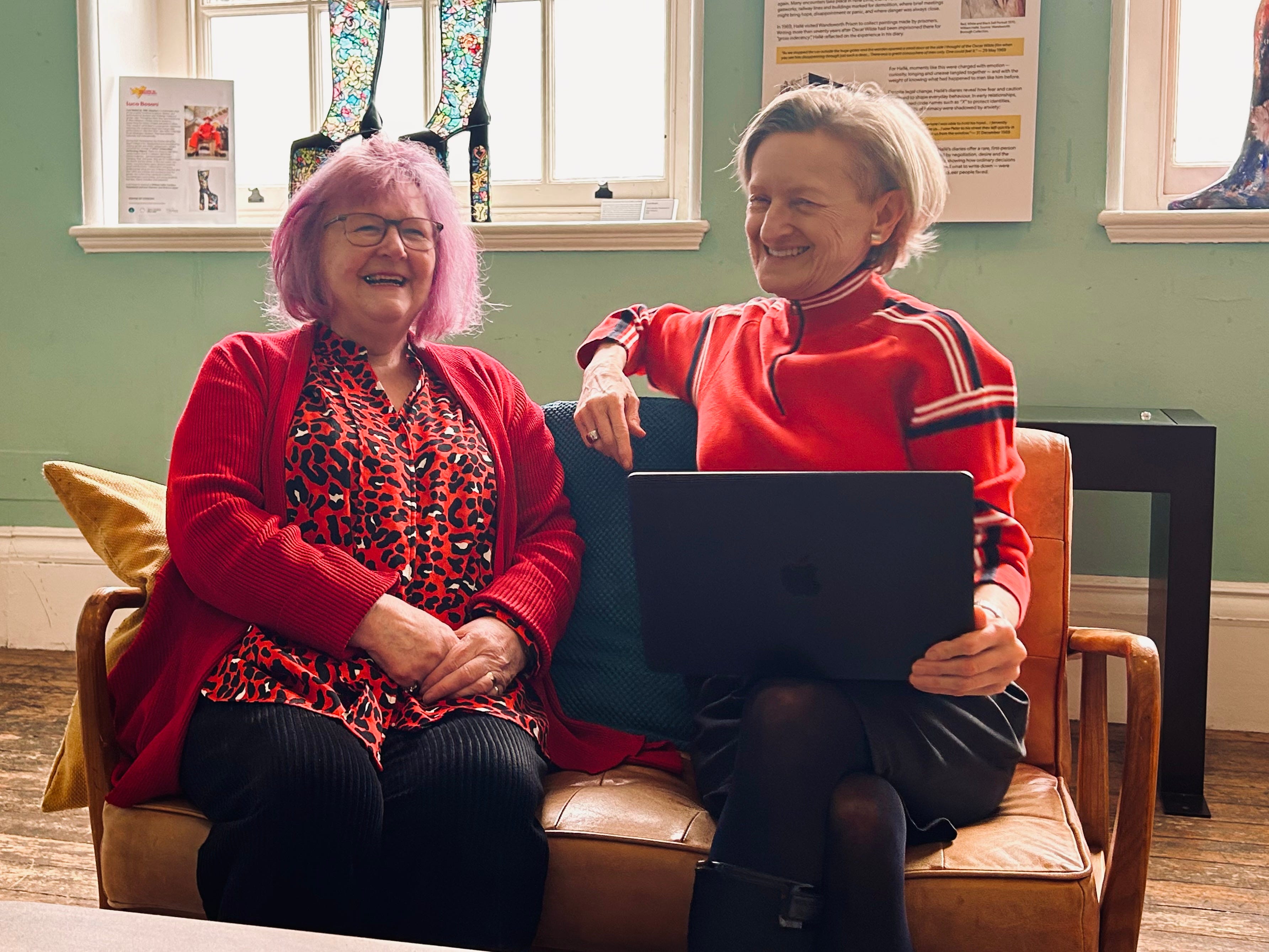
To find out, I talk to Jeanne R, feminist, historian, beautiful human. And a woman who wears purple in her hair.
Jeanne R
Spend time with Jeanne and you warm to her unapologetic fuck-it nature: she knows her mind and generously shares her story – the migration from Ireland, the liberated sixties, the political seventies. Her philosophy studies, 30 years a humanist celebrant, her meandering work-life, and now researching history.
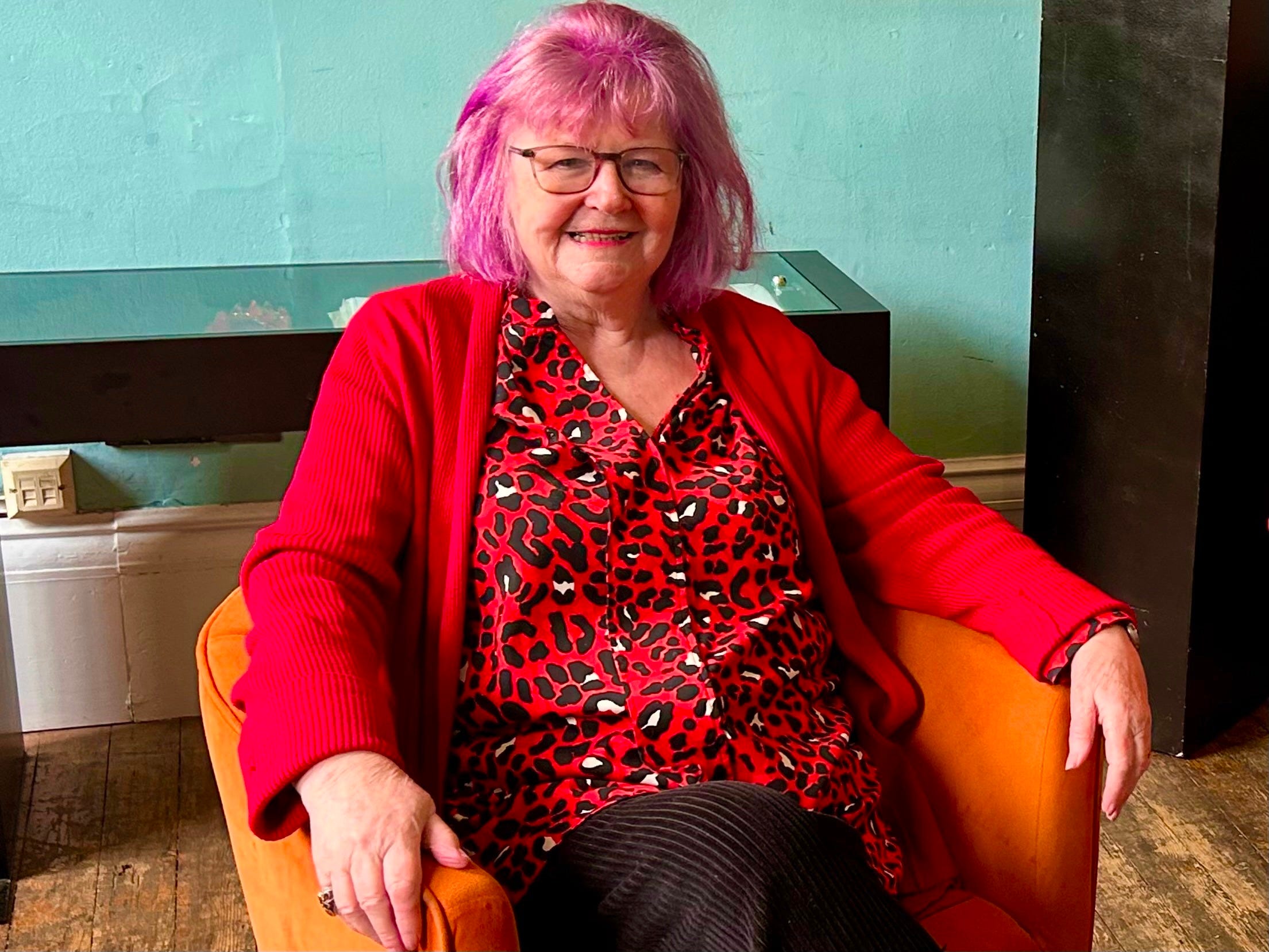
I ask Jeanne: You started dying your hair during the punk era - with food colouring. What did it mean to you?
Jeanne: It was in my late 20s. I was being mistaken for my son’s grandmother, a Celtic heritage meant early greying.
An inkling of vanity is immediately dispatched by her positioning of her choice: a rejection of conventional hair salon culture and practices which led to finding her solution. And purple? And pink? It was the punk era – Jeanne adds - this most liberating of hair-colouring eras, I think, as I remember my own platinum blonde modelling for a Mayfair salon.
Q: You use charity shops because, you say, it undermines capitalism and consumerism. When did you start thinking politically about shopping? Was that always how you approached things?
Jeanne: I have preferred second-hand clothes from early adulthood. Second-hand shopping has been Jeanne’s ecological choice and resistance to sweatshop production and department store distasteful uniformity, with racks and racks of identical mass-produced clothes.
Q: You landed as being a historian in / of our neighbourhood. What did you study and what was your work-life like?
An Irish Catholic upbringing, with a father insisting she studied science. Questioning was a practice from an early age – as was recognising sexism in the Irish Catholic Church.
She read philosophy as a mature student. A short career in comedy followed, with a one-woman show at the Edinburgh Festival, excoriating Catholic Church hypocrisy7.
She had roles as a women’s officer, a youth worker, a school governor. She was involved in educational policy for local authorities - a life-long commitment to community and working for others.
Labour party activism and community organising led eventually to the current role as researcher of local history – the blue and green plaques in Battersea are Jeanne making us pay attention to those who came before us.
Jeanne: I had a meandering career as a kept woman – her honesty, and wit, shine as she acknowledges the privilege of a husband’s support that gave her a liberating meandering freedom.
I reflect on how choice was not available to me as someone who had to fend for herself every day.
Jeanne: You must always remember that – she says, encouraging me to recognise the different nature of our lives – and I love her for it.
I end on a light/serious note: Looking at how you present yourself now - the pink hair, the sparkly beret, the strong colours. Did anyone ever tell you to tone anything down?
Jeanne: No.
The puzzled expression at the very thought tells me all I need. Privilege again, perhaps, but privilege that could have been put to lesser aims. There’s nothing to add.
But maybe I ought to practice a little now?
So people who know me are not too shocked and surprised
When suddenly I am old, and start to wear purple
I had wondered. Is women’s purple-hair-rebellion now to make up for conformity then? Is the timing backwards?
Jeanne taught me otherwise. As the conversation progressed, my theory exploded.
For Jeanne conformity never entered into the equation. What she was then she is now. Her critique of - and practice against - consumerism, sexism, injustice a fresh way to approach dull or dangerous things.
The purple hair, the eccentric clothes - it was always part of the package but what mattered, I see it clearly, was the seriousness of her purpose. That was her style, not the superficiality of her visual markers. Jeanne never practiced. She always was.
Six herons standing quietly in
A pool of water
— Charles Bukowski
Style is ethics, aesthetics, poetics. It is the beautiful image of the herons I leave you with.
Style is the answer to everything. It is how you choose to make your statement today.
On my 70th year on earth, my style is fearless art.
Fx
References
Mash “Style is the Answer” (Original Mix) by Glasgow Underground. On YouTube since 2012 - to much acclaim:
Bukowski reading Style to a ‘drunk raucous crowd’. Video published by Tyler McNeely on YouTube in 2015:
Good Housekeeping. 27 Nov 2025. These are the 12 key pieces you need for an anti-ageing and modern capsule wardrobe. One of the millions of examples of this ‘most diminishing of debates’.
The cliff that doesn’t exist, my first piece. Here:
I have found a reading of it by Jenny Joseph too - an opportunity to hear the cadence and tone she intended for her famous work, written in 1961 and twice voted ‘Britain’s favourite poem’. Here it is:
‘How I became Sheela-na-GIG’. Jeanne Rathbone on her comedy alter-ego. A blog published on Wordpress.
Francesca, thank you so much for this invitation to slow down and take a closer look at style. I read it earlier today on my phone, but I am glad to have a chance to read it again on my large computer screen in my office.
"There’s more to style. Style is how we confront dullness or danger. Style is a fresh way to navigate dull or dangerous realities and remain true in a world that tries to flatten us - in my reading of the poem." Love this.
The words "remain true" went straight to my heart. I am not entirely sure I know what my style is. I cared very much for fashion when I was in my teens and twenties. At one point in high school, I had aspirations to become a fashion designer. And then some time in my adult years, after leaving the corporate world, I began to see fashion as superficial. Yet, I still appreciate the aesthetics of a beautiful dress, a delicate fabric, a craftily hand-sewn hem.
I feel as though I compromised a lot growing up and in my younger years, but now I see things a lot more clearly. I feel myself speaking up more, and I intend to continue to do so.
I loved meeting Jeanne from your post. You are both so beautiful and radiant.
"Style is ethics, aesthetics, poetics – not fashion, not at any age. Even if we wear purple - or just a tasteful shade of grey." This is summed up so perfectly.
Love this! Style is a lifetime of experimenting and learning that gets better as we age x